
The golden ratio has shaped humanity’s greatest creations, from ancient pyramids to Renaissance paintings, embodying mathematical perfection in art and architecture across civilizations.

🌟 The Mathematical Poetry Behind Perfect Proportions
Throughout human history, certain proportions have consistently captivated the eye and stirred the soul. At the heart of this aesthetic magnetism lies a mathematical constant known as the golden ratio, represented by the Greek letter phi (φ) and approximately equal to 1.618. This seemingly simple number has woven itself into the fabric of countless architectural wonders and artistic masterpieces, transcending cultural boundaries and temporal limitations.
The golden ratio emerges when a line is divided into two parts such that the whole length divided by the longer part equals the longer part divided by the shorter part. This divine proportion, as Renaissance scholars called it, appears repeatedly in nature—from the spiral arrangement of seeds in sunflowers to the proportions of the human body—suggesting an inherent universal language of beauty that ancient civilizations intuitively grasped and deliberately employed.
Ancient Egypt: Pyramids Rising Toward Mathematical Heaven
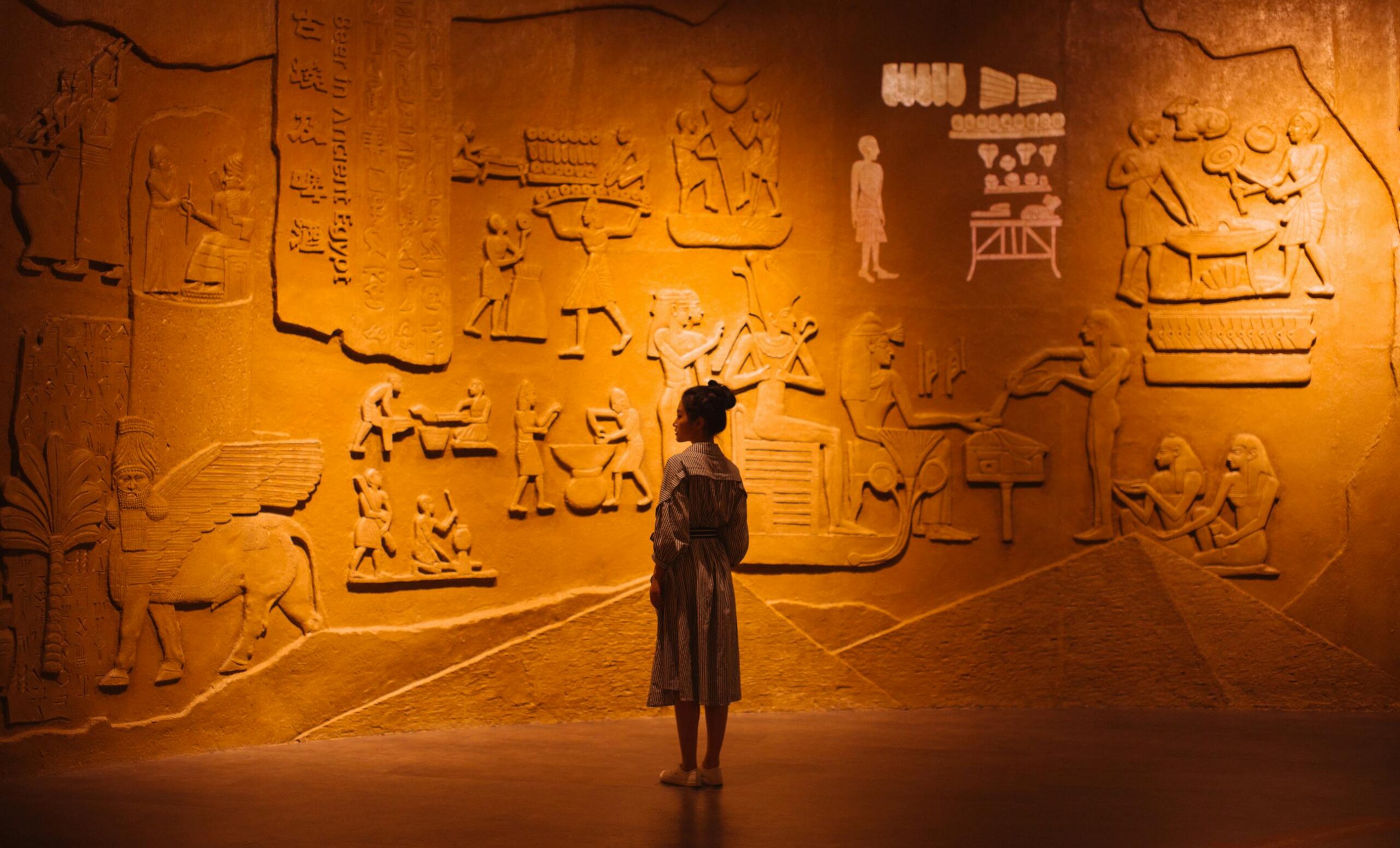
The Great Pyramid of Giza stands as perhaps the earliest monumental testament to the golden ratio’s architectural application. Constructed around 2560 BCE, this colossal structure demonstrates remarkable mathematical sophistication that continues to astound researchers. The ratio between the pyramid’s height and half its base length closely approximates phi, creating proportions that feel instinctively harmonious to observers.
Egyptian architects possessed profound understanding of geometry and proportion, though whether they consciously applied the golden ratio remains debated among scholars. Nevertheless, the presence of phi-related proportions in multiple Egyptian monuments suggests systematic knowledge rather than coincidence. The Temple of Luxor, with its carefully calibrated dimensions and proportional relationships between columns, chambers, and facades, further demonstrates this mathematical sensibility.
Ancient Egyptian art similarly embraced precise proportional systems. The canonical grid system used for depicting human figures divided the body into eighteen equal units, with key anatomical points aligning in ways that approximate golden ratio relationships. This standardized approach ensured aesthetic consistency across millennia of artistic production while maintaining visual harmony.
Classical Greece: Philosophy Carved in Marble 🏛️
Greek civilization elevated the golden ratio from practical tool to philosophical principle. The Parthenon, constructed between 447-432 BCE atop the Acropolis in Athens, represents the pinnacle of classical architectural achievement and golden ratio application. The temple’s facade demonstrates phi relationships in multiple dimensions—the ratio of its height to width, the spacing between columns, and the proportions of individual architectural elements all echo this mathematical constant.
Greek sculptor Phidias, after whom phi is named, incorporated golden proportions throughout the Parthenon’s sculptural program. The proportional relationships within individual sculptures and between sculptural elements and architectural features created unified aesthetic experience that transcended mere decoration. This integration of art and architecture through mathematical proportion embodied Greek ideals of harmony, balance, and perfection.
The golden rectangle, a shape whose sides are in phi proportion, became foundational to Greek architectural design. Architects subdivided these rectangles using the same proportional logic, creating nested harmonies that repeated across scales. This fractal-like approach produced buildings that felt coherent and aesthetically satisfying from both distant and intimate perspectives.
Roman Innovation: Engineering Meets Aesthetic Precision
Roman architects inherited Greek mathematical principles but applied them with characteristically pragmatic innovation. The Pantheon in Rome, completed around 126 CE, demonstrates sophisticated understanding of proportional relationships combined with engineering audacity. The building’s interior height equals its diameter, creating a perfect sphere-within-cylinder geometry, while various elements exhibit golden ratio proportions.
Roman arches and aqueducts, though primarily functional structures, incorporated aesthetic proportions that enhanced their visual impact. The Pont du Gard in southern France exemplifies this marriage of utility and beauty, with arch dimensions and tier relationships demonstrating phi-based proportional thinking. These structures proved that engineering excellence and aesthetic refinement need not be mutually exclusive.
Roman use of the golden ratio extended to urban planning and spatial organization. The layouts of forums, basilicas, and public spaces often employed proportional systems that created psychologically comfortable environments. This holistic approach to design influenced Western architectural thinking for subsequent centuries.
Islamic Architecture: Geometry as Divine Expression 🕌
Islamic civilization developed extraordinarily sophisticated geometric traditions that frequently incorporated golden ratio proportions, though approached through different mathematical frameworks than Western traditions. The intricate tessellations, muqarnas vaulting, and architectural proportions found throughout Islamic architecture demonstrate profound mathematical knowledge applied toward spiritual ends.
The Alhambra palace in Granada, Spain, completed in the 14th century, showcases Islamic geometric mastery. Its courtyards, chambers, and decorative patterns exhibit proportional relationships consistent with phi, creating spaces that feel simultaneously expansive and intimate. The Court of the Lions demonstrates particularly refined proportional thinking, with dimensions and spatial relationships producing remarkable acoustic and visual effects.
Islamic geometric patterns, with their repeating motifs and infinite expansion potential, often incorporate golden ratio relationships between pattern elements. These designs served both aesthetic and metaphysical purposes, representing divine infinity through mathematical precision. The integration of calligraphy, geometric pattern, and architectural form created unified artistic expressions that transcended individual media.
Renaissance Revolution: Rediscovering Ancient Wisdom
The Italian Renaissance witnessed renewed fascination with classical proportions and mathematical beauty. Luca Pacioli’s 1509 treatise “De Divina Proportione,” illustrated by Leonardo da Vinci, systematically explored the golden ratio’s properties and applications, codifying knowledge that Renaissance artists eagerly applied.
Leonardo da Vinci himself became perhaps history’s most celebrated golden ratio practitioner. His “Vitruvian Man” drawing elegantly demonstrates phi relationships throughout human anatomy. The “Mona Lisa” features multiple golden rectangles and spirals in its composition, contributing to the painting’s enigmatic appeal. Leonardo’s architectural drawings and engineering designs similarly incorporated these proportions, reflecting his belief that mathematics revealed nature’s fundamental organizing principles.
Renaissance architects including Filippo Brunelleschi and Leon Battista Alberti consciously applied golden ratio principles to their designs. The Florence Cathedral’s dome, Brunelleschi’s engineering masterpiece, demonstrates proportional relationships rooted in phi. Alberti’s treatises on architecture explicitly advocated mathematical proportion as the foundation of beauty, influencing generations of designers.
Beyond Europe: Golden Proportions Across Cultures 🌍
While European and Mediterranean civilizations receive disproportionate attention regarding golden ratio applications, other cultures independently discovered and employed similar proportional systems. The Forbidden City in Beijing, constructed during the Ming Dynasty, exhibits dimensional relationships consistent with phi, though Chinese architectural theory framed these proportions through different conceptual systems emphasizing cosmological harmony.
Traditional Japanese architecture and garden design demonstrate exquisite proportional sensitivity, with tatami mat dimensions, shoji screen divisions, and spatial relationships often approximating golden ratio proportions. The aesthetic principle of “ma” (negative space) incorporates proportional thinking that produces results functionally similar to Western golden ratio applications, though arising from distinct philosophical foundations.
Pre-Columbian American civilizations created monuments incorporating sophisticated mathematical proportions. Mayan pyramids and ceremonial centers demonstrate geometric precision and proportional relationships that, while not necessarily identical to phi, reveal comparable understanding of mathematics’ aesthetic potential. These parallel developments suggest that certain proportional relationships possess universal appeal transcending cultural specifics.
Modern Masters: Timeless Principles in Contemporary Form
Twentieth-century architects and artists continued exploring golden ratio applications while developing distinctly modern aesthetic languages. Le Corbusier developed his “Modulor” system, a proportional scale based on human dimensions and golden ratio relationships, which he applied throughout his architectural career. Buildings like the Villa Savoye and the United Nations Secretariat building incorporate Modulor proportions, demonstrating phi’s continued relevance to modern design.
Salvador Dalí explicitly incorporated golden rectangles and spirals into compositions like “The Sacrament of the Last Supper,” where a massive dodecahedron frames the scene according to phi proportions. Piet Mondrian’s abstract compositions, though superficially simple, often exhibit golden ratio relationships between colored rectangles and compositional divisions. These modern applications proved that mathematical proportion could serve avant-garde innovation as effectively as classical tradition.
Contemporary architects including Frank Lloyd Wright, I.M. Pei, and Norman Foster have acknowledged golden ratio’s influence on their work. Wright’s spiral design for the Guggenheim Museum in New York follows a logarithmic curve related to phi. These applications demonstrate that timeless proportional principles can generate fresh, innovative forms rather than mere historical pastiche.
The Science Behind the Beauty: Why Phi Pleases
Neuroscientific research has begun illuminating why golden ratio proportions consistently appeal across cultures and eras. Brain imaging studies suggest that viewing phi-proportioned compositions activates reward centers and produces measurably greater positive responses than random or alternative proportions. This neurological basis for aesthetic preference supports the notion that golden ratio beauty reflects something fundamental about human perceptual processing.
The golden ratio’s prevalence in nature may explain its aesthetic appeal through evolutionary psychology. Since humans evolved in natural environments where phi proportions appear frequently—in plant growth patterns, animal proportions, and landscape features—our visual systems may have developed preferences for these proportions as indicators of healthy, optimal natural forms. Artworks and architecture employing phi thus feel “natural” and comfortable.
Mathematical properties of the golden ratio contribute to its aesthetic effectiveness. Phi represents the “most irrational” number, meaning it’s maximally difficult to approximate with simple fractions. This quality may prevent visual systems from easily “solving” phi-proportioned compositions, maintaining interest through subtle complexity that neither overwhelms nor bores observers. The ratio’s self-similar properties, where each division produces new phi relationships, create coherent visual hierarchies across scales.
Creating With Phi: Practical Application Principles ✨
Understanding golden ratio theory differs significantly from applying it effectively in creative practice. Successful implementation requires sensitivity to context, purpose, and medium rather than rigid formula application. The ratio functions best as guiding principle rather than absolute rule, informing compositional decisions while allowing creative intuition and practical constraints to shape final results.
In architectural design, golden ratio can guide overall massing proportions, facade element relationships, window placement, and interior spatial divisions. Designers typically begin with approximate phi relationships, then adjust based on functional requirements, structural considerations, and site-specific factors. The goal involves achieving proportional harmony rather than mathematical exactitude—close approximations often prove more practically achievable and equally aesthetically effective as precise phi values.
Visual artists employ golden ratio through compositional armatures, determining placement of focal points, horizon lines, and major compositional divisions. The golden spiral, derived from nested golden rectangles, provides particularly useful compositional framework, guiding viewer attention through dynamic curves that feel naturally pleasing. However, masterful artists balance these mathematical guidelines with intuitive adjustments responding to specific content and expressive intentions.
Digital Age: Phi in Contemporary Design
Digital design tools have democratized golden ratio application while enabling unprecedented precision. Graphic designers regularly employ phi-based grids for logo design, page layouts, and user interface development. The ratio’s mathematical properties make it particularly suitable for responsive web design, where proportional relationships must maintain coherence across varying screen dimensions.
Typography increasingly incorporates golden ratio thinking, with type designers using phi to determine letterform proportions, x-heights, and character spacing. Some font families explicitly base their metrics on golden ratio relationships, producing typefaces with inherent proportional harmony. Web designers similarly apply phi to determine column widths, margin sizes, and typographic hierarchies.
Photography and digital image editing benefit from golden ratio overlays and compositional guides built into camera viewfinders and editing software. These tools help photographers apply centuries-old proportional wisdom to contemporary image-making, demonstrating how timeless principles adapt seamlessly to new technologies and media.
Beyond Numbers: The Soul of Proportion
While mathematical analysis reveals much about golden ratio’s properties and applications, something essential risks being lost when beauty becomes purely quantitative. The greatest architectural and artistic achievements incorporating phi transcend formula through creative vision, cultural context, and expressive intention. Numbers provide framework, but human imagination supplies meaning.
The golden ratio’s true significance may lie not in any mystical properties but in its service as tool for disciplined creative thinking. Proportional systems generally—whether based on phi, simple ratios, or other mathematical relationships—help designers make coherent decisions amid infinite possibilities. These frameworks enable systematic exploration while maintaining aesthetic consistency.
Ultimately, the golden ratio represents humanity’s enduring quest to understand and create beauty through reason. Across millennia and civilizations, people have sought mathematical keys to aesthetic perfection, finding in phi a proportion that somehow captures nature’s subtle harmonies. Whether encountered in ancient pyramids or modern museums, these proportions continue speaking a universal visual language that transcends words, cultures, and time itself—a truly timeless elegance carved in stone, captured in paint, and built into our collective architectural heritage.