
Long before the rise of modern wind turbines, humanity discovered ingenious ways to capture and harness the invisible force of wind for survival and progress.

The story of wind energy is far older than most people realize. While sleek, towering turbines dominate today’s renewable energy landscape, our ancestors developed remarkable techniques to transform moving air into mechanical power. These ancient innovations laid the groundwork for contemporary sustainable energy solutions and offer valuable lessons about resourcefulness, adaptation, and living in harmony with nature’s rhythms.
From the earliest sailboats that enabled maritime exploration to the sophisticated windmills that ground grain and pumped water, pre-industrial civilizations understood wind as both a challenge and an opportunity. Their methods were born from necessity, refined through generations of observation, and passed down as essential knowledge for community survival.
⛵ The Dawn of Wind Power: Sailing Through History
The first systematic harnessing of wind energy began on water. Ancient Egyptians were among the pioneers, using simple reed boats with square sails along the Nile River as early as 5000 BCE. These vessels revolutionized transportation, trade, and communication, allowing cargo and people to move upstream against the river’s natural flow.
Mesopotamian sailors soon followed, developing more sophisticated rigging systems that improved control and efficiency. The Phoenicians, renowned as master seafarers, advanced sail technology further, creating vessels capable of traversing the Mediterranean and venturing beyond the Pillars of Hercules into the Atlantic Ocean.
What made sailing such an effective wind-harnessing technique was its adaptability. Sailors learned to read wind patterns, understand seasonal changes, and position their vessels to maximize propulsion. This deep knowledge of atmospheric behavior became the foundation for all subsequent wind energy applications.
🌾 Grinding Grain: The First Land-Based Wind Machines
The transition from marine to terrestrial wind power marked a pivotal moment in human technological evolution. The first documented windmills appeared in Persia (modern-day Iran and Afghanistan) around 500-900 CE. These vertical-axis windmills featured a distinctly different design from their later European counterparts.
Persian windmills consisted of vertical rotating shafts with rectangular sails made from bundles of reeds or wood, arranged around the central axis. Walls channeled the prevailing winds into the rotor area, creating a controlled environment that maximized efficiency. These structures primarily ground grain, a labor-intensive task that previously required human or animal power.
The impact on agricultural societies cannot be overstated. Communities no longer depended solely on muscle power for one of civilization’s most fundamental processes. A single windmill could grind enough grain to feed hundreds of people, freeing human labor for other productive activities and contributing to economic growth and social development.
💨 Chinese Innovations: Bamboo and Balance
While Persia developed vertical-axis windmills, China independently created its own wind-harnessing technologies. Chinese engineers used wind power primarily for pumping water and operating bellows in metallurgical processes, showcasing the versatility of wind energy applications.
Chinese windmills featured lightweight bamboo construction, making them easier to build and maintain than stone or heavy timber structures. The materials reflected an understanding of engineering principles that balanced strength with flexibility, allowing the structures to withstand strong winds without catastrophic failure.
Buddhist monks also utilized small wind-powered prayer wheels, demonstrating that wind energy served spiritual as well as practical purposes. These devices rotated continuously when placed in windy locations, symbolizing the constant turning of the dharma wheel and the perpetual nature of religious devotion.
🏰 Medieval Europe: The Golden Age of Windmill Technology
European windmills emerged around the 12th century, likely introduced through contact with Middle Eastern cultures during the Crusades. The European design differed significantly from Persian models, featuring horizontal-axis rotors with four large sails extending outward from a central hub.
These iconic structures became landscape fixtures across the Netherlands, England, Spain, and other regions. The Dutch particularly embraced windmill technology, using it not only for grinding grain but also for pumping water from low-lying land, essentially creating new territory from marshes and coastal areas.
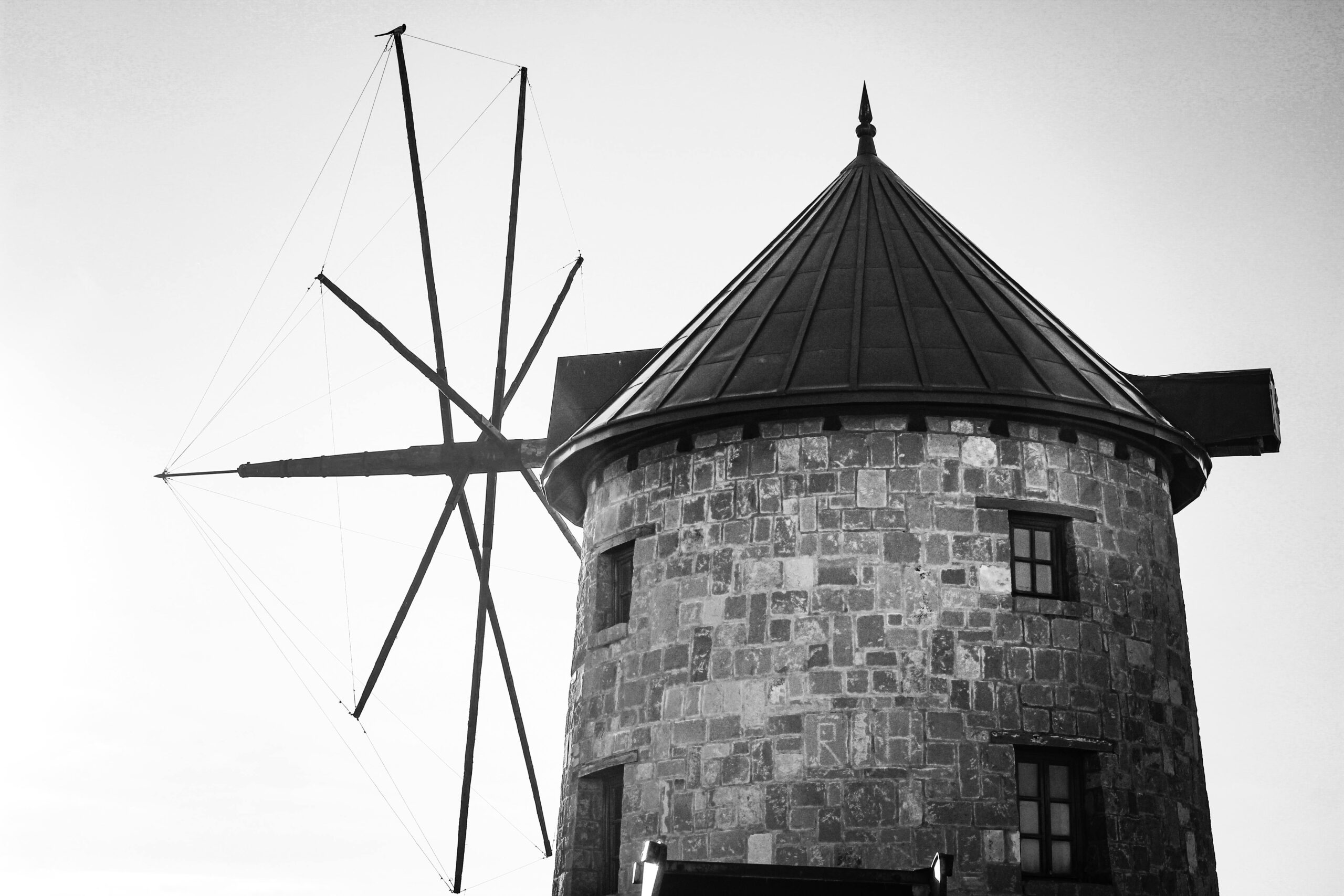
The tower mill and post mill represented two main European designs. Post mills balanced the entire mill structure on a single vertical post, allowing operators to rotate the building to face the wind. Tower mills featured a fixed stone or brick tower with only the cap and sails rotating, providing greater stability and capacity for larger grinding stones.
Architectural Ingenuity and Mechanical Sophistication
Medieval windmills demonstrated remarkable engineering sophistication. The fantail, invented in the 18th century, automatically kept the sails facing the wind by using a small auxiliary rotor mounted perpendicular to the main sails. This innovation eliminated the need for constant manual adjustment, significantly improving operational efficiency.
Spring sails, patented by William Cubitt in 1807, featured shutters that automatically opened and closed in response to wind strength, protecting the structure from damage during storms while maintaining optimal performance in varying conditions. This self-regulating mechanism represented an early form of automated power management.
Inside the mills, complex systems of gears and shafts transmitted rotational energy from the sails to millstones, demonstrating advanced understanding of mechanical advantage and energy transfer. Master millwrights possessed highly specialized knowledge passed down through apprenticeships, making them valued craftspeople in their communities.
💧 Water Management: Windmills as Hydraulic Engineers
Beyond grain processing, windmills played a crucial role in water management throughout history. The Netherlands provides the most dramatic example, where hundreds of drainage windmills worked continuously to keep the low-lying polders dry, preventing flooding and creating arable farmland below sea level.
These drainage mills used Archimedean screws or chain-and-bucket systems to lift water from lower areas to higher drainage canals. The mills operated in coordinated sequences, with water passing through multiple stages before reaching the sea or river level where it could safely discharge.
In arid regions of the Mediterranean and Middle East, windmills pumped water from wells for irrigation, making agriculture possible in otherwise marginal lands. These applications demonstrate how wind energy supported food security and territorial expansion long before fossil fuels became available.
🔨 Industrial Applications Beyond Agriculture
As wind technology matured, applications diversified beyond grain milling and water pumping. Industrial windmills powered sawmills, cutting timber for construction and shipbuilding. Paper mills used wind power to pulp rags and other fibrous materials. Spice mills ground pepper, mustard, and other valuable commodities for trade.
The oil industry in its earliest form relied on wind-powered crushing mills to extract oil from seeds and nuts. Paint pigments were ground using wind energy. Even some early textile operations used windmills to power fulling mills, which cleaned and thickened cloth through mechanical beating.
This industrial diversification illustrated a fundamental principle: once communities developed the infrastructure and expertise to harness wind energy, they found countless applications for this reliable, renewable power source. The limiting factor was not imagination but mechanical transmission technology.
🌍 Global Variations: Wind Power Across Cultures
Different regions developed wind-harnessing techniques adapted to local conditions, materials, and needs. In Tibet, prayer flags served as both spiritual objects and early examples of harnessing wind’s energy for symbolic purposes, carrying prayers and mantras across mountainous landscapes.
American Plains settlers in the 19th century developed small wind pumps specifically designed for water extraction from deep wells, supporting agricultural expansion into previously uninhabitable territories. These multi-blade windmills became iconic symbols of rural American life and remained common well into the 20th century.
Greek islands utilized distinctive white-painted windmills with cloth sails that could be easily adjusted or removed, adapted to Mediterranean wind patterns and the local economy based on grain production and shipping.
⚙️ Engineering Principles That Transcend Time
Ancient wind-harnessing techniques embodied engineering principles that remain relevant today. The most fundamental was understanding that wind power is intermittent and variable, requiring either energy storage solutions or flexible operational strategies.
Traditional millers developed sophisticated knowledge of wind behavior, learning to predict weather changes from atmospheric signs and adjust their operations accordingly. This intimate relationship with natural patterns contrasts with modern expectations of constant, controllable power supply.
Material selection represented another crucial principle. Ancient engineers chose materials that balanced strength, weight, durability, and local availability. Reed, wood, canvas, and stone each served specific functions based on their mechanical properties and environmental context.
Efficiency Through Simplicity
Traditional wind machines achieved remarkable efficiency through elegant simplicity rather than complex technology. The direct mechanical connection between sails and millstones minimized energy loss during transmission. Regular maintenance and adjustment optimized performance without requiring specialized replacement parts or technical expertise beyond local capabilities.
This approach to efficiency offers lessons for contemporary renewable energy development. While modern turbines achieve higher conversion rates, they depend on global supply chains, specialized materials, and complex maintenance protocols. Ancient techniques demonstrated that appropriate technology matched to local contexts and capabilities can provide sustainable solutions.
📚 Knowledge Transmission: The Master and Apprentice System
Wind-harnessing expertise passed through generations via the apprenticeship model. Master millwrights trained young apprentices over many years, sharing not just construction techniques but also the subtle knowledge of wind patterns, structural maintenance, and operational optimization that could only be learned through experience.
This knowledge transmission system ensured that communities maintained the capacity to build, repair, and operate wind-powered machines without dependence on external experts or proprietary technologies. The distributed nature of this expertise contributed to the resilience and sustainability of wind power systems.
Guild systems in Europe formalized this training, establishing standards for quality and competence while protecting the economic interests of skilled craftspeople. These organizations preserved technical knowledge and promoted innovation within traditional frameworks.
🌱 Environmental Harmony: Living With Natural Rhythms
Ancient wind energy systems embodied a fundamentally different relationship with nature compared to fossil fuel technologies. Rather than extracting and depleting finite resources, these systems worked in partnership with renewable atmospheric flows, accepting natural variability as an inherent condition rather than a problem to be overcome.
This approach required flexibility in human activities. Grain was ground when wind blew; sailboats departed when favorable winds arrived. Communities organized economic and social life around natural patterns rather than imposing rigid schedules regardless of environmental conditions.
Modern society often views this arrangement as limiting or primitive, but it represented a sustainable adaptation that allowed civilizations to flourish for millennia without depleting resources or destabilizing climate systems. The wisdom embedded in these practices deserves reconsideration as we confront environmental challenges.
🔄 Lessons for Contemporary Renewable Energy Development
Ancient wind-harnessing techniques offer valuable insights for modern sustainable energy transitions. The principle of distributed generation—many smaller installations serving local needs rather than massive centralized facilities—characterized traditional windmill systems and increasingly influences contemporary renewable energy planning.
The importance of local materials and manufacturing capacity emerges clearly from historical examples. Traditional windmills could be built, maintained, and repaired using regionally available resources and skills, creating energy security independent of distant supply chains. Modern renewable energy development might benefit from greater emphasis on localized production and maintenance capabilities.
Energy storage remains a challenge today, just as it was for ancient civilizations. Historical solutions included storing processed goods (ground grain), using wind power opportunistically when available, and accepting intermittency as normal rather than problematic. These approaches might complement battery technology and other storage solutions in creating resilient energy systems.
🎯 Rediscovering Ancient Wisdom in Modern Contexts
The techniques our ancestors developed for harnessing wind energy represent more than historical curiosities. They embody principles of sustainability, resilience, and environmental harmony that remain relevant—perhaps increasingly so—in an era of climate change and resource depletion.
Small-scale wind projects, appropriate technology movements, and efforts to revive traditional knowledge all draw inspiration from pre-industrial wind power systems. These initiatives recognize that bigger and more technologically complex does not always mean better, especially when considering long-term sustainability, community autonomy, and environmental impact.
The challenge facing contemporary society is integrating the wisdom embedded in traditional practices with modern scientific understanding and technological capabilities. This synthesis might produce energy systems that combine ancient principles of working with nature with contemporary efficiency and scale, creating truly sustainable solutions for future generations.
By studying how our ancestors unleashed the power of wind through ingenuity, observation, and deep environmental knowledge, we gain perspective on our own energy challenges and possibilities. The ancient windmills, sailing vessels, and water pumps represent not primitive technology but sophisticated solutions that sustained civilizations for thousands of years—a record modern systems have yet to match.