
Sacred spaces have always been designed not just for visual grandeur, but to create profound auditory experiences that connect worshippers with the divine through sound.

🏛️ The Sacred Symphony: Where Architecture Meets Acoustics
Throughout human history, architects and builders have understood that sacred structures serve a purpose far beyond mere shelter. These spaces are designed to facilitate spiritual transcendence, and sound plays a crucial role in this journey. The intersection of acoustic science and architectural design in religious buildings represents one of humanity’s most sophisticated artistic achievements, where physical space is sculpted to shape the very air that carries prayers, hymns, and sacred music to both earthly congregations and heavenly realms.
The relationship between sound and spirituality is deeply embedded in human consciousness. From the resonant chanting in Buddhist temples to the soaring organ music in Gothic cathedrals, acoustic design has been instrumental in creating atmospheres conducive to worship and contemplation. Ancient builders, though lacking modern acoustic measurement tools, possessed an intuitive understanding of how sound behaves in enclosed spaces, developing techniques that continue to inspire contemporary architects.
Ancient Wisdom: The Foundations of Sacred Acoustics
Long before the scientific study of acoustics emerged, ancient civilizations demonstrated remarkable sophistication in designing spaces with exceptional sound qualities. The Greek amphitheaters, though not exclusively religious, showcased principles that would later influence sacred architecture. At the Theater of Epidaurus, built in the 4th century BCE, a whisper on stage can be heard clearly in the back row, demonstrating an understanding of sound propagation that predates modern physics by millennia.
In religious contexts, this knowledge was applied with even greater intentionality. The Hagia Sophia in Constantinople, completed in 537 CE, features a massive dome that creates a reverberation time of approximately eleven seconds. This extended echo was not accidental but designed to blur individual voices into a unified, heavenly chorus that seemed to emanate from the divine itself rather than from human throats.
The Mathematics of Divine Proportions
Medieval builders employed geometric principles and mathematical ratios believed to reflect cosmic order. The golden ratio and other sacred proportions influenced not only visual aesthetics but also acoustic properties. Spaces designed with these proportions naturally produced harmonious sound environments, reinforcing the belief that the structure itself embodied divine principles.
Cistercian monasteries provide excellent examples of this approach. Built between the 11th and 13th centuries, these structures featured specific dimensional relationships that enhanced Gregorian chant. The monks understood that their plainsong required a reverberation time of approximately two seconds for optimal clarity and beauty—a specification they achieved through careful attention to volume, surface materials, and spatial proportions.
🎵 The Science Behind the Sacred Sound
Modern acoustic science has revealed the complex physics underlying these ancient achievements. When sound waves encounter surfaces, they can be reflected, absorbed, or diffused, depending on the material properties and geometric configurations. Sacred structures strategically employ these principles to create specific auditory experiences that enhance religious practice.
Reverberation time—the duration sound persists after the source stops—is perhaps the most critical acoustic parameter in sacred spaces. Different religious traditions and musical forms require different reverberation characteristics. A cathedral designed for organ music might target a reverberation time of six to eight seconds, creating the majestic, enveloping sound that makes this instrument so powerful. Conversely, a space intended primarily for spoken liturgy requires shorter reverberation times, typically one to two seconds, to maintain speech intelligibility.
Material Matters: Surface Choices and Sound Quality
The materials selected for sacred structures profoundly impact their acoustic character. Stone, wood, marble, and glass each interact with sound waves differently, and skilled architects combine these materials to achieve desired effects. Hard, smooth surfaces like polished marble reflect sound efficiently, contributing to longer reverberation times and a sense of spaciousness. Softer materials like wood absorb certain frequencies while reflecting others, adding warmth and tonal complexity.
Gothic cathedrals exemplify strategic material use. Their stone vaults and walls provide ample reflective surfaces for sustaining sound, while wooden choir stalls and other furnishings absorb excessive high frequencies that might otherwise create harshness. The result is a balanced acoustic environment where music gains richness and power without becoming muddy or overwhelming.
Architectural Elements as Acoustic Instruments
Every architectural feature in a sacred structure can be understood as contributing to its acoustic signature. Domes, vaults, columns, and even decorative elements all influence how sound travels and transforms within the space. This section explores the acoustic functions of key architectural components.
The Dome: Heaven’s Resonance Chamber
Domes have graced sacred architecture across cultures—from the Pantheon in Rome to Islamic mosques to Renaissance churches. Acoustically, domes create unique sound distribution patterns. They focus sound energy, often creating “whisper galleries” where sounds travel along the curved surface, allowing quiet conversations to be heard at surprising distances. This phenomenon reinforces the mystical quality of sacred spaces, suggesting invisible connections and divine presence.
The dome’s contribution to reverberation depends on its size, shape, and surface treatment. Large domes with smooth interiors create extended reverberation with complex reflection patterns that make sound seem to come from everywhere and nowhere simultaneously—an effect that enhances the transcendent atmosphere essential to many religious experiences.
Columns and Spatial Division
Columns serve structural purposes but also function as acoustic elements. They diffuse sound waves, breaking up direct reflections and creating a more uniform sound distribution throughout the space. In large basilicas, colonnades prevent sound from traveling too directly from one end to another, which could create echoes or dead spots where certain frequencies cancel out.
The spacing and arrangement of columns affect how sound wraps around the space. Byzantine churches often featured columns arranged to create multiple acoustic zones, allowing different liturgical activities to occur simultaneously without excessive interference—a practical consideration when services could last several hours with various participants.
🕌 Cultural Variations in Sacred Acoustics
Different religious traditions have developed distinct acoustic priorities based on their liturgical practices and theological perspectives. Understanding these variations reveals how deeply acoustic design is integrated with spiritual expression across cultures.
Christian Churches: The Voice of the Organ
Western Christian architecture, particularly in the Catholic and Orthodox traditions, evolved in close relationship with liturgical music. The pipe organ, introduced to churches in the Middle Ages, became the quintessential sacred instrument, and churches were designed to showcase its power and majesty. The long reverberation times characteristic of Gothic and Baroque churches allow organ music to build upon itself, creating harmonic complexity and emotional intensity.
Protestant traditions, emerging in the 16th century, often prioritized preaching over music, leading to different acoustic requirements. Some Protestant churches were designed with shorter reverberation times to ensure sermon clarity, though musical traditions remained important in many denominations.
Islamic Mosques: Clarity for the Call
Islamic architecture approaches acoustics with different priorities. The call to prayer (adhan) and Quranic recitation require excellent speech intelligibility, leading to acoustic designs that minimize excessive reverberation. Many mosques feature carpeted floors and soft furnishings that absorb sound, creating drier acoustic environments compared to Christian cathedrals.
However, mosques also employ acoustic enhancement techniques. Domes and vaults provide controlled reflections that amplify the human voice without electronic reinforcement, ensuring that the imam can be heard throughout the prayer hall. The mihrab (prayer niche) often functions as an acoustic reflector, projecting the imam’s voice back toward the congregation.
Eastern Temples: Resonance and Ritual
Buddhist and Hindu temples approach sacred acoustics through entirely different paradigms. Many incorporate elements specifically designed to produce sound, such as resonant bells, gongs, and singing bowls. The architecture complements these sound-producing objects rather than focusing primarily on voice or instrumental music.
Tibetan Buddhist temples often feature low ceilings and relatively small volumes, creating intimate acoustic environments where the deep tones of ceremonial horns and the complex overtones of throat singing can be fully appreciated. Japanese Shinto shrines, by contrast, frequently incorporate open structures where natural sounds—wind, rain, rustling leaves—integrate with ritual activities, dissolving boundaries between sacred and natural worlds.
⚡ Modern Challenges and Contemporary Solutions
Contemporary sacred architecture faces challenges unknown to ancient builders. Modern construction materials, building codes, climate control systems, and electronic sound reinforcement all impact acoustic design. Additionally, many sacred spaces now serve multiple functions, requiring acoustic flexibility that traditional designs cannot provide.
Balancing Tradition and Technology
Many contemporary religious communities desire both traditional architectural aesthetics and modern amenities. This creates acoustic dilemmas: HVAC systems generate background noise that can interfere with music and speech; concrete and steel have different acoustic properties than traditional stone and wood; large glass windows, popular in modern design, reflect sound differently than masonry walls.
Acoustic consultants now work alongside architects from the earliest design phases, using computer modeling to predict how spaces will sound before construction begins. These tools allow designers to experiment virtually, testing different materials, geometries, and configurations to achieve optimal results while maintaining architectural vision.
Adaptive Acoustics: Spaces That Transform
Some contemporary sacred structures incorporate adjustable acoustic elements, allowing the same space to accommodate different activities. Movable panels, retractable curtains, and variable acoustic absorption systems enable a church to provide long reverberation for organ concerts while offering clarity for spoken services or contemporary worship with amplified instruments.
These technological solutions represent a philosophical shift. Rather than designing for a single ideal acoustic condition, modern sacred architecture increasingly embraces multiplicity, recognizing that diverse forms of worship and community gathering each deserve appropriate acoustic support.
🎼 The Human Experience: Psychology of Sacred Sound
Beyond the physics and engineering, acoustic design in sacred structures profoundly affects human psychology and spiritual experience. The way sound behaves in these spaces shapes emotional responses, influences attention and contemplation, and can facilitate transcendent experiences that worshippers describe as encountering the divine.
Envelopment and Transcendence
When reverberation is appropriately designed, listeners experience acoustic envelopment—the sensation of being surrounded and embraced by sound. This phenomenon, measurable through binaural recording techniques, correlates strongly with feelings of awe, peace, and connection that many people report in sacred spaces.
Neuroscience research suggests that acoustic envelopment activates brain regions associated with emotion and social bonding. When a congregation sings together in a space with supportive acoustics, individuals not only hear their own voices enhanced but perceive themselves as part of a unified sonic whole—a powerful reinforcement of community identity and shared purpose.
Silence and Stillness
Paradoxically, the acoustic design of sacred spaces must also support silence. Contemplative traditions emphasize quiet meditation, and even in more active liturgical contexts, moments of silence carry profound meaning. A well-designed sacred space possesses acoustic quietude—low background noise levels and controlled external sound intrusion—allowing silence to become a palpable presence rather than merely the absence of sound.
Achieving true acoustic quietude in contemporary contexts requires careful attention to sound isolation. Traffic noise, HVAC systems, and adjacent activities all threaten the sanctity of silence. Modern sacred architecture employs sophisticated sound isolation techniques, including double-wall construction, acoustic baffles, and strategic site selection to preserve the possibility of meaningful silence.
🌟 Lessons for Contemporary Architecture
The principles developed through centuries of sacred acoustic design offer valuable insights for contemporary architecture beyond religious contexts. Concert halls, theaters, museums, and even educational facilities benefit from understanding how architectural space shapes auditory experience and, through it, human consciousness and behavior.
The integration of acoustic considerations from the earliest design phases—rather than treating them as afterthoughts—represents perhaps the most important lesson from sacred architecture. When form and acoustics develop together, spaces achieve coherence that satisfies both visual and auditory senses, creating environments that feel complete and purposeful.
Additionally, the recognition that different activities require different acoustic characteristics encourages thoughtful design that truly serves user needs rather than imposing a single aesthetic vision regardless of functional requirements. This user-centered approach, implicit in the best sacred architecture, deserves wider application across all building types.
Preserving Acoustic Heritage for Future Generations
Many historic sacred structures face threats from environmental changes, structural deterioration, and well-intentioned but acoustically damaging renovations. Preserving these spaces requires understanding their acoustic properties as part of their cultural heritage, equally important as their visual and historical significance.
Acoustic archaeology—the study and documentation of historical sound environments—has emerged as a vital field. Researchers use advanced measurement techniques to capture the acoustic signatures of significant spaces, creating acoustic archives that preserve this intangible heritage even if physical structures change or disappear. These recordings and measurements inform restoration projects and inspire new designs that honor acoustic traditions while serving contemporary needs.
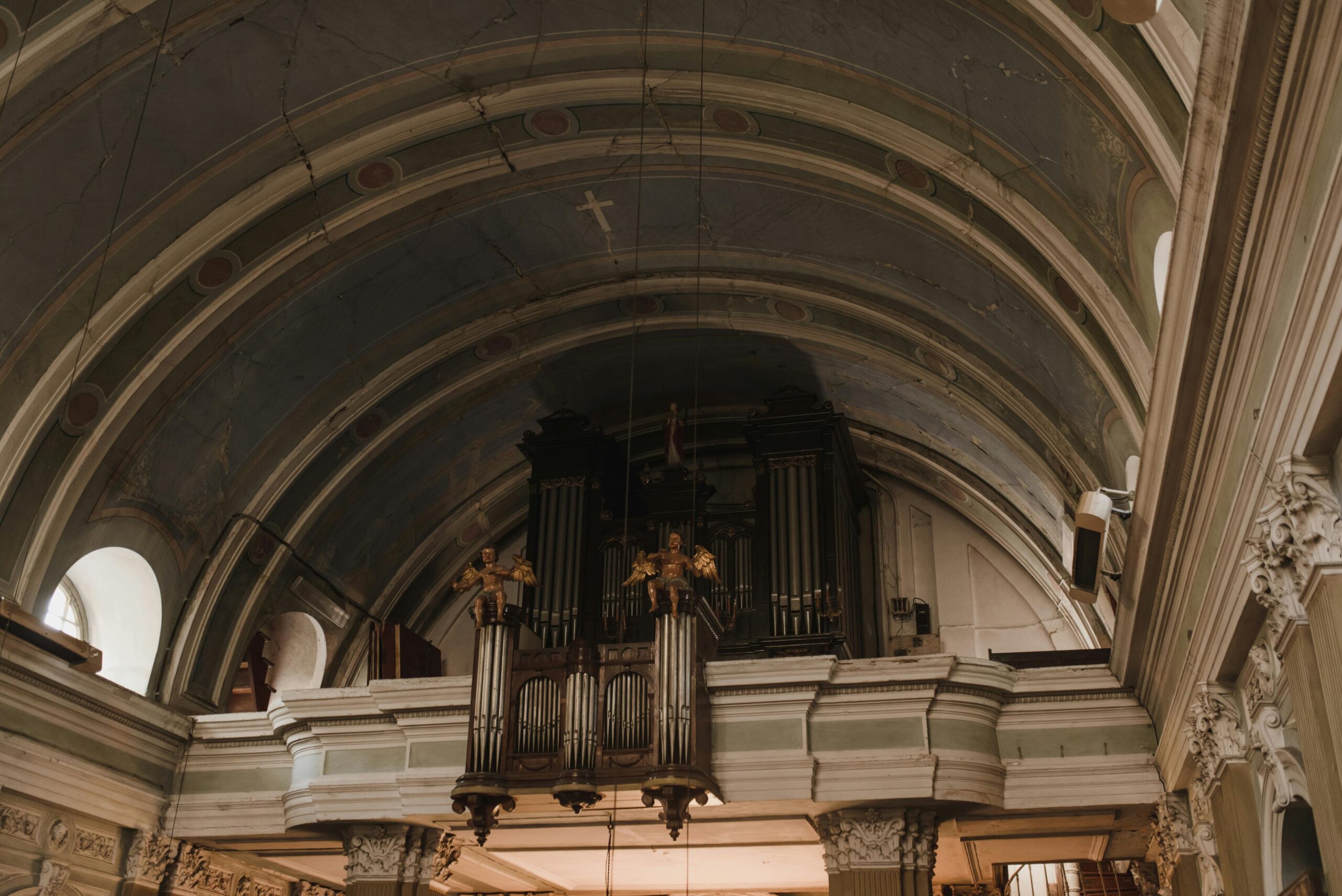
The Eternal Conversation Between Stone and Song
The art of acoustic architecture in sacred structures represents humanity’s ongoing attempt to create spaces worthy of our highest aspirations and deepest spiritual longings. Through stone and wood, geometry and proportion, ancient builders and modern architects alike strive to give physical form to the invisible realm of sound, crafting environments where earthly voices can resonate with heavenly harmonies.
As we continue to design and build sacred spaces, the lessons learned from centuries of acoustic wisdom remind us that architecture is never purely visual. Space becomes place through the sounds it shapes, the voices it amplifies, the silence it protects. In harmonizing heaven and earth through thoughtful acoustic design, we create not just buildings but instruments—vast, complex instruments that play upon human consciousness itself, inviting transcendence and transformation through the eternal power of sound.