
Mandalas represent one of humanity’s most captivating intersections between art and mathematics, blending spiritual symbolism with geometric precision to create stunning visual masterpieces that have fascinated cultures worldwide for centuries.

🎨 The Ancient Origins of Mandala Design
The word “mandala” derives from Sanskrit, meaning “circle” or “completion.” These intricate geometric patterns have deep roots in Hindu and Buddhist traditions, where they served as spiritual tools for meditation and contemplation. Beyond their religious significance, mandalas embody a universal language of symmetry and balance that transcends cultural boundaries.
Throughout history, civilizations from Tibet to Native American tribes have independently developed mandala-like patterns, suggesting an innate human attraction to radial symmetry and organized complexity. This phenomenon reveals something profound about how our brains process visual information and find comfort in mathematical order.
Today, mandala construction has evolved from purely spiritual practice into a widespread art form embraced by designers, mathematicians, educators, and wellness practitioners. The therapeutic benefits of creating mandalas have been documented in art therapy programs worldwide, demonstrating their power beyond aesthetic appeal.
Understanding the Mathematical Foundation of Mandalas
At their core, mandalas are exercises in mathematical precision. Every traditional mandala begins with a central point, from which all other elements radiate outward in perfect symmetry. This fundamental structure relies on concepts that mathematicians have studied for millennia: radial symmetry, rotational patterns, and geometric progression.
The construction of a mandala typically involves dividing a circle into equal segments, often using angles that are divisors of 360 degrees. Common divisions include 4, 6, 8, 12, or 16 sections, each creating different visual effects while maintaining perfect symmetry. This mathematical approach ensures that whatever pattern appears in one section repeats identically throughout the entire design.
The Role of Sacred Geometry
Sacred geometry forms the backbone of mandala design, incorporating shapes believed to hold special significance across cultures. The circle represents wholeness and unity, the square symbolizes stability and earthly existence, and triangles point toward higher consciousness or divine energy.
When these geometric forms combine within a mandala, they create complex patterns that follow specific mathematical ratios. The golden ratio (approximately 1.618) often appears in traditional mandala proportions, creating aesthetically pleasing relationships between different elements. This ratio, found throughout nature in spirals, flower petals, and shell formations, lends mandalas their organic, harmonious appearance.
Essential Tools and Materials for Mandala Creation ✏️
Creating mandalas requires surprisingly few tools, though the right instruments make the process significantly easier and more precise. Traditional mandala artists worked with basic compasses and rulers, but modern creators have access to specialized equipment that streamlines construction while maintaining artistic integrity.
For beginners starting their mandala journey, the essential toolkit includes:
- A quality compass for drawing perfect circles of varying sizes
- A protractor or angle divider for creating symmetrical sections
- Rulers with millimeter markings for precise measurements
- Mechanical pencils with hard lead (2H or harder) for light construction lines
- Fine-tipped pens or markers for final linework
- High-quality paper with smooth texture to prevent ink bleeding
- An eraser for removing construction guidelines
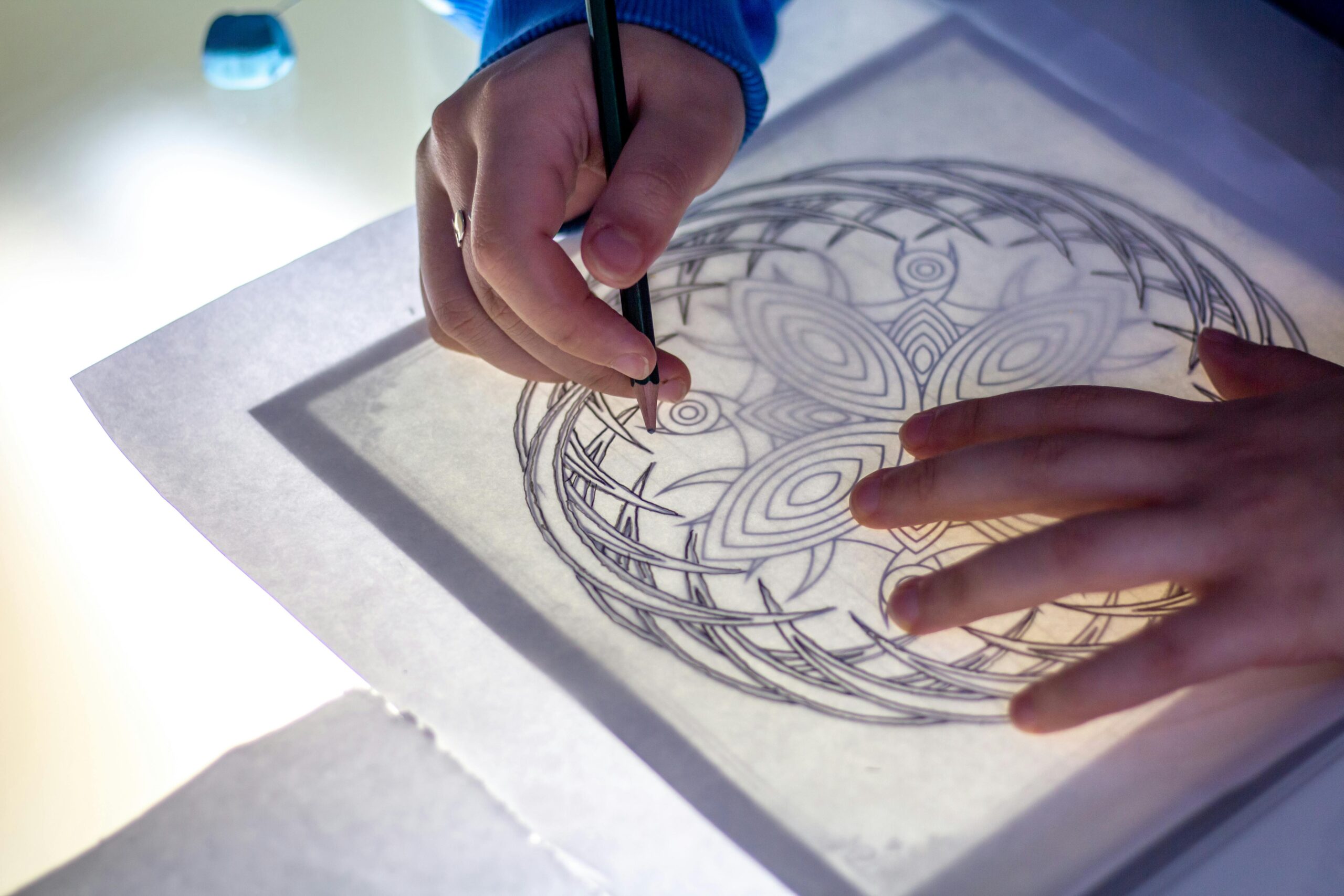
Advanced practitioners often invest in specialized mandala-drawing tools, including circular rulers with pre-marked angle divisions, flexible curves for creating organic flowing lines within geometric structures, and light boxes for transferring designs. Digital artists utilize software with rotation symmetry features that automatically replicate designs across multiple axes.
Step-by-Step Mandala Construction Process
Building a mandala from scratch might seem daunting, but breaking the process into manageable steps reveals its accessible nature. Every complex mandala begins with simple geometric foundations that gradually evolve into intricate patterns through patient, methodical work.
Establishing the Foundation Circle
Begin by determining your mandala’s overall size and marking the center point on your paper. Using a compass, draw your outermost boundary circle. This perimeter defines the limits of your design and serves as a reference point for all subsequent elements.
Next, create several concentric circles inside the boundary, each progressively smaller. These circles function as guides for placing design elements at consistent distances from the center. Most mandalas feature between three and seven concentric rings, though complex designs may include many more.
Dividing Your Circle Into Symmetrical Sections
Select your desired number of divisions—eight sections create accessible symmetry for beginners, while twelve or sixteen sections allow for more intricate patterns. Use your protractor to mark equal angles around the center point, then draw light guideline radii connecting the center to the outer circle.
These radiating lines create the “pie slice” divisions that ensure perfect rotational symmetry. Whatever design you create in one section must be precisely replicated in all others, transforming individual artistic choices into coherent whole compositions.
Developing Your Pattern Design 🔍
Within one section, sketch your desired pattern using the concentric circles as placement guides. Traditional mandala elements include lotus petals, geometric shapes, dots, lines, and abstract flowing forms. The key is maintaining awareness of how your design will repeat around the entire mandala.
Start simple with your first few mandalas, perhaps using basic petal shapes or triangular patterns. As your confidence grows, introduce more complex elements like interconnected spirals, intricate borders, and layered geometric forms that create depth and visual interest.
Replicating Across All Sections
Once satisfied with one section, carefully replicate it in each remaining division. This repetition demands patience and precision—small inconsistencies become magnified when multiplied around the entire design. Many artists trace their initial section onto transparent paper, then rotate this template to ensure exact replication.
After completing all sections, step back and evaluate the overall composition. The moment when disparate sections unite into a coherent mandala provides one of the most satisfying experiences in art creation, revealing the power of mathematical organization to produce beauty.
The Psychology Behind Mandala Creation and Appreciation
Scientific research increasingly validates what contemplative traditions have known for centuries—creating and viewing mandalas produces measurable psychological benefits. The process of constructing these symmetric patterns engages both brain hemispheres, combining the logical, mathematical left side with the creative, artistic right side.
This bilateral brain activation creates a meditative state similar to focused mindfulness practices. As creators concentrate on precise measurements and repetitive pattern-making, anxiety-producing thoughts naturally quiet, replaced by absorption in the present moment. The predictable structure provides comfort, while artistic choices within that structure offer creative freedom.
Studies have shown that mandala creation reduces cortisol levels, decreases anxiety symptoms, and improves focus and concentration. Art therapy programs worldwide incorporate mandala exercises for treating trauma, managing stress, and supporting emotional processing. The circular format itself provides psychological containment—a safe, bounded space for exploring feelings and experiences.
Digital Tools Revolutionizing Mandala Design 📱
Technology has dramatically expanded access to mandala creation, allowing people without traditional drawing skills to design intricate patterns using digital tools. Specialized applications use mathematical algorithms to generate symmetry automatically, letting users focus purely on aesthetic choices while the software handles geometric precision.
Digital mandala creation offers unique advantages over traditional methods. Artists can experiment freely without committing to permanent marks, trying different color schemes, patterns, and compositions instantly. The undo function eliminates the fear of mistakes that sometimes inhibits creative exploration. Additionally, digital files can be scaled to any size without quality loss, making them suitable for everything from phone wallpapers to large-format prints.
Many mandala apps include features like pre-designed templates, customizable symmetry options (from 4-fold to 32-fold or beyond), layer systems for building complex designs, and export capabilities for sharing or printing finished work. These tools democratize mandala creation, making it accessible to anyone with a smartphone or tablet.
Therapeutic Applications in Modern Wellness Practices 🧘
Mental health professionals increasingly incorporate mandala work into therapeutic interventions. The structured yet creative nature of mandala design provides an ideal medium for clients who find purely verbal therapy challenging or insufficient.
In clinical settings, therapists might ask clients to create mandalas representing specific emotions, experiences, or goals. The circular boundary provides psychological safety while the symmetry requirement encourages organization of chaotic thoughts and feelings. Analyzing completed mandalas can reveal unconscious patterns, with color choices, shape preferences, and overall composition offering insights into emotional states.
Beyond formal therapy, many individuals maintain regular mandala practices as self-care rituals. The predictable structure offers comfort during difficult periods, while the creative elements provide outlets for expression and processing. Some practitioners create daily mandalas as visual journals, tracking emotional evolution through their designs over time.
Incorporating Mandalas Into Educational Settings
Educators across disciplines recognize mandalas as powerful teaching tools that make abstract concepts tangible and engaging. Mathematics teachers use mandala construction to demonstrate geometric principles, symmetry, angles, and spatial relationships in ways that feel creative rather than purely computational.
The multidisciplinary nature of mandalas allows integration across curriculum areas. History classes explore cultural mandala traditions, art programs develop technical drawing skills, and geometry lessons become hands-on creative projects. This cross-curricular approach helps students see connections between seemingly separate subjects, developing holistic understanding.
Research indicates that students retain mathematical concepts better when learned through artistic application. Creating mandalas transforms abstract geometric principles into concrete, visible outcomes, making learning memorable and meaningful. The inherent beauty of finished mandalas provides intrinsic motivation, encouraging students to persevere through challenging technical requirements.
Advanced Techniques for Experienced Mandala Artists
As skills develop, mandala creators often seek greater challenges and complexity in their work. Advanced techniques push beyond basic radial symmetry into more sophisticated mathematical and artistic territory.
Multi-Layered Compositions
Complex mandalas often feature multiple overlapping layers, each with different symmetry patterns or rotational alignments. Creating these requires careful planning to ensure layers complement rather than clash visually. Transparency effects, where lower layers remain partially visible beneath upper elements, add depth and sophistication to designs.
Integrating Organic and Geometric Elements
Masterful mandala design balances rigid geometric precision with organic, flowing forms. This combination creates visual tension and interest—the predictability of mathematical structure contrasts beautifully with naturalistic elements like vines, flowers, or abstract flowing lines that suggest movement and life.
Color Theory and Mandalas 🎨
While many mandalas use black ink on white paper, introducing color adds another dimension of complexity and expression. Advanced color work considers color theory principles—complementary colors create vibrancy, analogous colors produce harmony, and value contrasts establish focal points and depth.
Traditional mandala coloring follows symbolic systems where specific colors carry particular meanings. Red represents passion and energy, blue conveys tranquility and spirituality, yellow symbolizes learning and wisdom, while green connects to growth and healing. Contemporary artists may honor these traditions or develop personal color languages within their work.
The Meditative Practice of Mandala Coloring
Even those uncomfortable with original design can experience mandala benefits through coloring pre-drawn patterns. The adult coloring book phenomenon of recent years placed mandalas at the forefront, introducing millions to their calming effects.
Coloring within defined spaces requires enough concentration to quiet mental chatter while remaining accessible to people at all skill levels. The repetitive motion of filling sections with color induces relaxation similar to other meditative practices. Unlike blank page creation, coloring provides structure that reduces performance anxiety while still allowing creative expression through color choices.
Researchers studying adult coloring found that mandala coloring specifically produces greater anxiety reduction than coloring other patterns or free-form drawing. The mandala’s circular structure and symmetry appear to offer unique psychological benefits beyond general coloring activities.
Bringing Mathematical Art Into Your Daily Life 🌟
Mandala practice need not remain confined to dedicated art sessions. These versatile patterns can integrate into various aspects of daily life, spreading their calming, centering influence throughout your environment and routines.
Many practitioners create mandala morning rituals, spending fifteen minutes drawing simple designs as a mindful start to the day. Others maintain mandala journals, creating small designs alongside written entries to represent emotional states or significant experiences. The process becomes a form of moving meditation, grounding awareness in the present moment before engaging with daily demands.
Displaying completed mandalas throughout living and working spaces serves as visual reminder of balance and harmony. The symmetric patterns can subtly influence mood and mental state, providing focal points for quick meditative moments during busy days. Some people rotate displayed mandalas seasonally or based on current needs—energizing designs during low-motivation periods, calming patterns during stressful times.
The Universal Language of Symmetry and Pattern
Perhaps mandalas’ most remarkable quality is their cross-cultural universality. Despite developing independently across civilizations, mandala-like patterns share fundamental characteristics, suggesting they tap into deep-seated human responses to symmetry and geometric order.
This universality makes mandalas powerful communication tools that transcend language barriers. The mathematical precision underlying their construction represents a truly international language—geometric principles function identically regardless of culture, while the visual impact of symmetry resonates with viewers worldwide.
As global connections increase, mandalas serve as bridges between traditions, honoring ancient wisdom while remaining relevant to contemporary life. They remind us that beneath surface cultural differences lie shared human experiences and aesthetic responses, connecting us through our common attraction to beauty, order, and meaning.
The fusion of artistic expression and mathematical precision in mandala construction offers something increasingly rare in modern life—an activity that simultaneously engages multiple aspects of human capability. Creating these intricate patterns exercises logical thinking and creative imagination, fine motor skills and holistic vision, patience and spontaneity. Whether approached as spiritual practice, artistic pursuit, mathematical exercise, or therapeutic tool, mandalas provide accessible entry into mindful awareness and the profound satisfaction of creating beauty through precision.